Canoe or Kayak? Six Questions to Help You Choose the Right Solo Boat

Insights from the team at Adirondack Lakes & Trails Outfitters, Saranac Lake, NY — paddling specialists since 1999

When customers come into our shop in Saranac Lake looking for their first solo boat, one of the most common questions we hear is: "Should I get a canoe or a kayak?" It's a great question — and the honest answer is: it depends. After 25 years of helping paddlers explore the Adirondacks, we've learned that the right boat is almost always the one that best matches how you plan to use it.
This guide focuses on flatwater paddling craft for lakes, rivers and canoe camping — rather than whitewater, fishing or touring kayaks. If you're planning to paddle on waters like Upper Saranac Lake, the St. Regis Canoe Area, the Raquette River or the Saranac Lake Islands, these are the questions you need to answer before you buy.

1. How will you typically use the boat?
This is the most important question, and the one most people get stuck on. The temptation is to plan for every possible scenario — but that often leads to a compromise boat that doesn't do any one thing particularly well.
Think honestly about how you'll use the boat most of the time. Day trips on a local lake? Multi-day canoe camping? Exploring moving water? The answer will point you clearly toward a canoe or kayak, and toward specific hull designs within each category. If your use cases are genuinely varied, consider renting a different boat for the occasional exception rather than buying a compromise you'll paddle every week.
2. What's your budget?
Having a rough budget in mind helps narrow the field quickly. As a general guide:
A quality recreational plastic canoe or kayak: $800–$1,300. Heavier and more durable. Good for casual use and learning.
Lightweight composite canoe or kayak: $2,500–$5,000. Significantly lighter, faster, and better suited to longer trips. More care required, though composite boats are more robust than most people expect.
We carry boats across both price ranges in our Saranac Lake shop, including composite canoes from Swift Canoe & Kayak and Wenonah, and plastic recreational kayaks from Perception and Wilderness Systems. Canoes and kayaks hold their value well, particularly composite boats in good condition. It's also worth looking at used options if you're buying your first boat and we also sell used boats periodically.

3. Is boat weight important to you?
Weight affects three things: transport, portaging, and on-water performance.
Transport
A heavy plastic boat on a roof rack is manageable with the right loading system, but if you're solo-loading a 70-lb canoe onto your car regularly, it gets old fast. Clever rack systems (we carry Thule and Yakima) can help, but a composite boat in the 20–35 lb range removes the problem entirely.
Portaging
If you're planning multi-day trips in the Adirondacks — particularly routes involving carries between lakes — weight matters enormously. The Adirondack canoe routes involve real portages on real trails. A Swift Cruiser 14.8 at around 28 lbs is a completely different experience to carrying a 60-lb plastic boat over a half-mile trail.
Performance
Lighter boats are faster and easier to paddle efficiently, but they're also more susceptible to wind — a factor worth considering on open Adirondack lakes. Heavier boats track more steadily in windy conditions. Neither is universally better; it depends on where and how you paddle.
4. How much do you need to carry?
If you're packing camping gear, bringing a dog, or paddling with a child sitting in front of you, a canoe is almost always the better choice. Kayaks have a closed top deck which limits access and storage — some recreational kayaks have larger cockpit openings, but the fundamental space constraints remain.
Canoes offer open, accessible storage, flexible seating arrangements, and the ability to pack dry bags, coolers and camping kit with far more freedom. For multi-day Adirondack canoe camping trips — the kind we help plan every season — a canoe is the clear choice.
5. How much paddling experience do you have?
Experience level affects both the canoe-vs-kayak decision and which specific model will suit you best.
Kayaks tend to feel more stable to new paddlers for two reasons: recreational kayaks typically have a wider, flatter hull and a lower seating position, which gives a reassuring initial stability. The double-bladed paddle is also easier to learn — it provides more power per stroke and makes course corrections more intuitive.
Canoes require a little more technique — particularly around balance and efficient paddle technique — but this is learned quickly. The key to stable canoe paddling is simple: keep your head centered over the boat, rest your knees lightly against the sides for connection, and let your hips do the work when the water gets choppy.
The Pack Canoe: worth knowing about
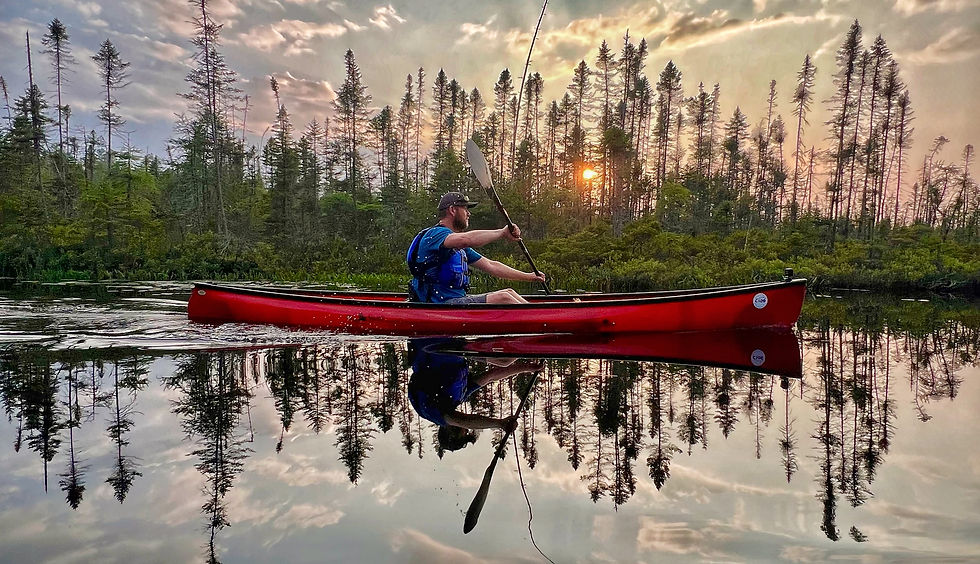
If you find yourself drawn to both options, the Pack Canoe is worth serious consideration. Pack canoes like the Swift Cruiser 14.8 or Wenonah Wee Lassie use a kayak-style double-blade paddle but have an open canoe hull — no deck, easier to get in and out of, and much more storage than a kayak. They're very popular with solo canoe campers and experienced paddlers in the Adirondacks. We're an authorized Swift test paddle center — one of very few in the Northeast — and we offer personalized demo sessions on Pack Canoes and other solo boats.

6. What happens if you tip?
Recovery techniques differ significantly between canoes and kayaks, and both are genuinely difficult for inexperienced paddlers to execute reliably on open water.
Our honest advice: don't plan your boat choice around recovering from a capsize. Plan around not capsizing in the first place — stay closer to shore while building confidence, always wear your PFD, and paddle within your current ability level.
Summary: Canoe or Kayak?
Choose a canoe if:
You're planning multi-day canoe camping trips
You need to carry gear, a child, or a dog
You want more versatility and open storage
You're paddling routes with portages, especially in the Adirondacks
You want a more traditional paddling experience
Choose a kayak if:
You're primarily day-tripping on flatwater
You want an easier learning curve
You'll be paddling in exposed conditions where a lower profile helps
Speed and efficiency are a priority
Consider a Pack Canoe if:
You want the feel and efficiency of a kayak with the open storage and access of a canoe
You're a solo paddler planning camping trips
You want one boat that does almost everything well
Our Recommendation: Try Before You Buy
No amount of research replaces a few minutes in the water. Boats that look similar on the rack can feel completely different under you — hull shape, seat height, rocker and width all affect how a boat performs in ways that aren't obvious until you're paddling it.
We offer free personalized demo sessions at our Saranac Lake shop for anyone considering a boat purchase. We'll put you in two or three boats, talk through what you noticed, and help you make the right call. There's no pressure and no obligation. Call us at (518) 891-7450 or book a personalized demo session directly on our web site below

Adirondack Lakes & Trails Outfitters is located at 8 Church Street, Saranac Lake, NY. We are an authorized dealer for Swift Canoe & Kayak, Wenonah, Esquif, Perception, Wilderness Systems, Hurricane, SIC and NRS, and an authorized Swift Test Paddle Center.